Skip to product information
1 of 6

Gold Note

Gold Note PH-10 Phono Stage

Gold Note PH-10 Phono Stage

Regular price $3,580.00 AUD
Regular price Sale price $3,580.00 AUD
Sale Sold out
Shipping calculated at checkout.
Finish
Quantity

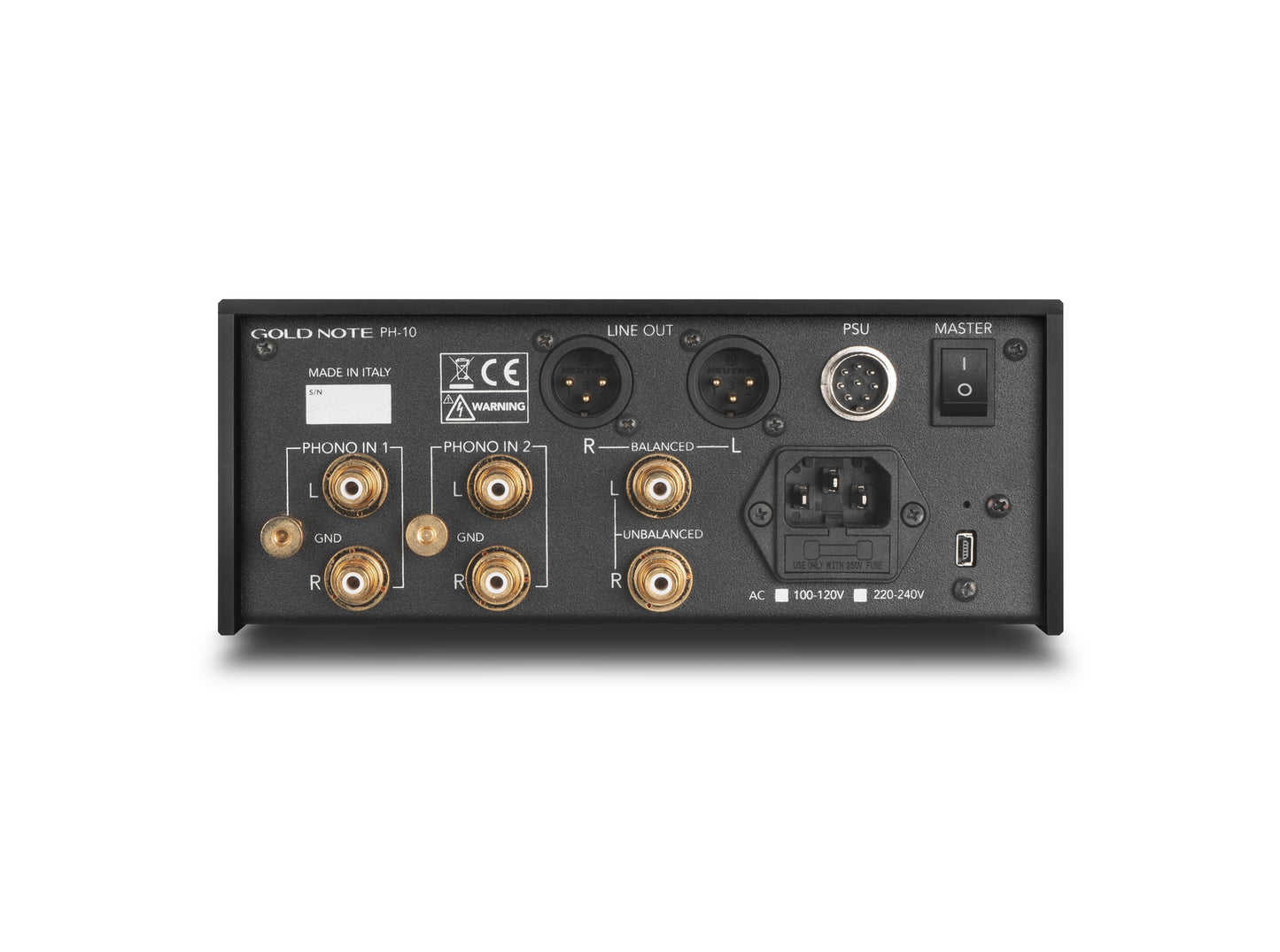
The Gold Note PH-10 is a phono preamplifier engineered for flexible vinyl playback and precise cartridge matching. It offers dual independent stereo RCA inputs with per-input memory so you can connect two tonearms or turntables and recall distinct gain and loading settings instantly.

If you struggle with matching MC or MM cartridges swapping tonearms or reproducing correct equalization for different pressings this unit helps by providing six selectable EQ curves including RIAA Decca London and American Columbia plus enhanced options for extended frequency response. Wide adjustable gain from 45-65dB and nine loading positions from 10Ω to 47kΩ let you tailor the signal without external adapters.

  • Six selectable EQ curves including RIAA Decca London and American Columbia
  • Universal MM and MC support with 9 loading positions 10Ω to 47kΩ and 45-65dB adjustable gain
  • Dual independent stereo RCA inputs with per-input memory for tonearm-specific settings
  • Measured performance <0.05% THD 89dB signal-to-noise ratio and 105dB dynamic range
  • RCA unbalanced and XLR balanced outputs XLR provides +12dB higher level

Compared to single-input phono stages the PH-10 reduces setup time and avoids repeated cartridge reloading by storing settings per input. It is compatible with Gold Note PSU-10 or PSU-5 external power supplies for further noise reduction and stability. The all-analog signal path includes an infrasonic filter and documented electrical specifications to ensure consistent measurable results. Request technical measurements or consult our support team to confirm compatibility with your cartridge before purchase.

View full details

Frequently Asked Questions

Will the Gold Note PH-10 work with both moving-magnet and moving-coil cartridges?
Yes. The Gold Note PH-10 supports both MM and MC cartridges with a wide, measurable range of loading and gain options. It offers nine loading positions from 10 ohms to 47 kiloohms and adjustable gain between 45 and 65 dB, which covers the common electrical requirements of most moving-coil and moving-magnet cartridges. The unit’s measured performance is documented at less than 0.05% THD with an 89 dB signal-to-noise ratio and 105 dB dynamic range, so it can preserve low-level detail across cartridge types. Audiophiles, collectors, and anyone switching between MM and MC cartridges benefit most because the PH-10 lets you tune loading and gain precisely for each cartridge. Note that you still need to set the correct physical cartridge alignment and ensure your amplifier or DAC has an available line input for the PH-10’s outputs.
Can I connect two turntables or tonearms to the PH-10 and keep separate settings?
Yes. The PH-10 includes dual independent stereo RCA inputs with per-input memory so you can connect two turntables or tonearms and recall separate loading, gain, and EQ settings instantly. This design eliminates repeated manual reconfiguration when switching tonearms or cartridges and lets you store distinct configurations for each input. The benefit is immediate switching without compromising cartridge matching or playback quality, making it ideal for collectors who swap pressings, DJs who use multiple arms in a listening setup, and archivists handling varied sources. As a limitation, the PH-10 is an external phono preamplifier and requires a line-level input on your amplifier or DAC to receive its RCA or balanced XLR outputs.
Does the PH-10 offer alternate equalization curves beyond RIAA, and why does that matter?
Yes. The PH-10 provides six selectable EQ curves including standard RIAA plus Decca London and American Columbia, each with an enhanced option for extended frequency response. These alternate curves reproduce the intended tonal balance and frequency compensation used on historical or specialty pressings, which matters for accurate restoration and faithful playback of non-RIAA recordings. The selectable curves are implemented in an all-analog signal path with an infrasonic filter, preserving analog character while giving measurable and repeatable EQ choices. Archivists, vinyl purists, and listeners of vintage pressings benefit most because the PH-10 can match the original mastering curve. If you primarily play modern RIAA-encoded records, the extra curves are optional rather than essential.
How does the balanced XLR output compare to the RCA output on the PH-10?
The PH-10’s balanced XLR output delivers a higher output level and improved noise immunity compared with the unbalanced RCA output. Specifically, the XLR output provides approximately +12 dB higher level, which can be useful when connecting to professional-grade preamplifiers or long cable runs where common-mode noise rejection matters. The unit’s measured signal-to-noise ratio of 89 dB and 105 dB dynamic range further support low-noise operation when using balanced connections. Professional studios, high-end system setups, and users with long interconnect runs benefit most from XLR output. If your amplifier or receiver only accepts RCA line inputs, the unbalanced RCA output remains fully functional and convenient for typical home systems.
Is the PH-10 easy to set up and fine-tune for cartridge matching?
Yes. The PH-10 is designed for straightforward setup and precise cartridge matching by offering clearly marked gain and loading steps, six EQ curve selections, and per-input memory for two tonearms. The nine loading positions from 10 ohms to 47 kiloohms and adjustable 45 to 65 dB gain let you dial in electrical settings without external resistors or adapters, and the dual-input memory stores those settings for instant recall. These measurable controls reduce trial-and-error, making setup faster for enthusiasts, installers, and technicians. Keep in mind that correct mechanical setup of the tonearm and cartridge alignment is still required for optimal tracking and tracking weight, so cartridge alignment tools and a good protractor are recommended alongside the PH-10’s electrical adjustments.
Will using an external PSU improve the PH-10’s performance?
Yes. Using Gold Note external power supplies such as compatible PSU-10 or PSU-5 can improve the PH-10’s performance because external PSUs typically provide cleaner, more stable voltage and reduced noise compared with standard internal supplies. The PH-10 is specified with low distortion and high dynamic range, and pairing it with a dedicated external supply can further lower noise floor and improve transient clarity in demanding systems. Critical listeners, audiophiles pursuing incremental performance gains, and studio users benefit most from adding an external PSU. That said, the PH-10 performs to its specified measurements with its standard supply, so an external PSU is an upgrade for those seeking further refinement rather than a prerequisite for proper operation.
How durable is the PH-10 and what finishes are available?
The PH-10 is built in a brushed aluminium chassis with a solid-feel construction, and it is offered in Black, Silver, or Gold finishes. Its metal enclosure, 3 kilogram weight, and compact 200 mm by 80 mm by 260 mm dimensions indicate a sturdy, studio-capable build that resists vibration and offers long-term durability in normal home or professional environments. The anodized or brushed surface is easy to keep clean and resists minor wear from handling. Audiophile installations, studio racks, and regular home use scenarios benefit most from this build quality. As with any precision electronics, avoid exposing the unit to excessive moisture or heat and use gentle cleaning to protect the finish.
Is the PH-10 suitable for archival or restoration work?
Yes. The PH-10 is well suited to archival and restoration tasks because it provides selectable historical EQ curves, precise loading options from 10 ohms to 47 kiloohms, adjustable gain up to 65 dB, and an all-analog signal path that preserves source character. Its documented electrical performance, including less than 0.05% THD, 89 dB signal-to-noise ratio, and 105 dB dynamic range, offers measurable fidelity important when preserving or digitizing delicate pressings. Archivists and restoration engineers benefit most from the combination of repeatable settings and alternate equalizations for nonstandard pressings. Note that archival workflows often require additional equipment such as a high-resolution ADC, turntable isolation, and careful mechanical alignment to complement the PH-10’s electrical precision.
Can I use the PH-10 with a modern integrated amplifier or will I need extra components?
Yes, you can use the PH-10 with a modern integrated amplifier provided the amplifier has a line-level input. The PH-10 outputs a line-level signal via unbalanced RCA and balanced XLR connectors, so it connects like any external preamplifier to an amplifier’s AUX, CD, or line input. The PH-10’s +12 dB higher XLR level option and measured 89 dB signal-to-noise ratio make it flexible for both consumer and pro-line inputs. Home listeners, owners of integrated amps without a dedicated phono stage, and those upgrading from a built-in phono input benefit most. If your amplifier lacks any line inputs, you would need an external preamp or a different routing solution to integrate the PH-10.
What listening environments and users get the most value from the PH-10?
The PH-10 delivers the most value in critical listening environments where cartridge matching, selectable EQ, and low-noise performance matter. Its combination of dual independent inputs with per-input memory, nine load settings, six EQ curves, and documented specs such as <0.05% THD, 89 dB SNR, and 105 dB dynamic range make it ideal for audiophiles, vinyl collectors, archivists, and studio engineers who need repeatable, measurable control. The compact, brushed aluminium chassis and balanced XLR output also suit professional setups and long cable runs. For casual listeners who rarely change cartridges or play only modern RIAA records, a simpler phono stage may be sufficient; the PH-10 is optimized for those who need precise control and flexibility.